Friday, September 9, 2022

My Life with Dyslexia

I want to tell you a story…   it won’t be about my fear of flying this time.  For the most part, constant air travel has cured me of that phobia.  It’s about something else that has plagued me my entire life, but went undiagnosed until I turned 50.   A true disability, from which, I adapted, like a three-legged dog, and never knew I was disabled.  I don’t know if this is a success story or some other commentary on the political landscape we created when we started holding ceremonies for our kids graduating from kindergarten…giving each one a trophy.   I do remember, in New Jersey, on or about 1974, my soccer team came in second place in the League.   Satisfied with the team’s performance, our coaches took us out for pizza and gave each one of us a second-place trophy. I cherished that trophy.  It stills sit’s in my office today. It didn’t make me soft. It made me proud.  And with pride, and confidence, much like any four-legged dog, I moved through life wagging my tail and compensating for the things I lacked without realizing I was even a dog, let alone with three legs.

From a very early beginning I was detrayed by my words.  My mom always told me I couldn’t spell because I learned phonetically in public school and the failure of phonics must have been the reason I sucked at spelling.  She had one data point.  How could a smart kid like me not be able to spell?  It plagued her for her entire life.   It must have been the phonetic spelling lessons she reasoned countless times when I asked her how a word was spelled.   Imagine one day early in my life, while trying to spell the word detrayal, I realized it was actually spelled with a ‘b”.  Well, I felt betrayed by the system.  How could I have missed that one so badly?  Sure, they knew about dyslexia back in the 70’s.  I even remember my best friend David’s mother, Mrs. Simms, explaining to me that if you had dyslexia, you would flip your “S’s” backward.  From then and there I was on the lookout for the telltale sign of the flipped S.   As it turns out, to a dyslexic, a flipped “S” is the absolute least of your problems.   A flipped “b” and a “d” on the other hand, robs you of your innocence.  Let’s not even talk about a flipped “p” and a “q” because that’s just mean.

So, with that very first betrayal of the school system going off fully undiagnosed, I launched into my mediocre school life never quite understanding I had a issue, or is it a problem?  Fast forward another 40 years. Successful completion of high school, college, a BS in Engineering, a Master’s in Liberal Arts, and a Second Master’s in Operations Research.  I was an officer in the USAF.  A system’s engineer at a large corporation.   I ran my own business and also became a federal civilian for a number of years.  And now in my twilight years, I’m still a high functioning dyslexic with abysmal hand-writing skills.  And I still can’t spell for shit.  How did I discover, finally, about my disability?

Let’s talk about something that is a flaw in my character.  I never wanted my daughter to fail.  She struggles in math.  I’ve written extensively on what I believed to be the root cause of her math failures…her 6th grade math teacher…who called all of her students, young mathematicians.   I called her Bloody Mary for the way she forced my daughter out of STEM.  If you want more of that story you can read about it here, “Blood Mary and the Paradox of 6th Grade Math Teachers”.  My daughter had to successfully complete some math to graduate high school.   Maybe, and I’m not confirming or denying this part, her dad helped her with her math homework.  Perhaps he actually completed some, or all, of her math homework.  When this caring father, we will call him dad, completed his own work in school, he never checked his math.  He’s kind of confident dude, bold, gusting to arrogant on most occasions.  But he never checked his math.  Why would he check his math?  It’s right!  The math is right!  That’s probably a longer story…and as it turns out…the very subject of this essay.  But because Dad was completing the math work for his daughter, he felt that if he was doing someone else’s work, and turning it in for a grade, he ought to check the math.  Imagine, for the first time in his life, checking his math and finding some of it wrong.  WTF?  How did he make that mistake.  He flipped a 25 and a 52.  That’s a rookie error, not a disability.  Imagine, however, after a semester of math, and checking his own homework over and over again, for the very first time, finding many similar errors.   Not a lot of errors, but a sufficient number of errors to turn an “A” homework into a “C” homework.   A passing grade.  Had there been sufficient errors to turn his “A” homework assignments in school into failing grades, perhaps Dad wouldn’t have a story to tell.  He would have known.  As it turns out, his disability slipped through the cracks.  A passing grade.  Two-O and go.  As they say.  He stayed on the edge.  It was seemingly more than enough to get by.  But it was a mediocre, at best, getting by.

But now, at age 50, it caught his attention big time.  Also, he had just changed career paths.  Moving from management, into program support, that required relearning a bunch of math.  And, not just relearning math, working in computer programming with lower lever machine language, verse higher level languages.  It would be hard enough, for a dyslectic to write code…but perhaps no harder than writing, and perhaps easier because a complier will find errors caused by misspelled variables, for instance.  A built-in editor.  But now I was working in hexadecimal and binary.  One of the first things you learn when working with hexadecimal and binary in a computer architecture is the endianness of the processor.  Since in a computer architecture, it’s arbitrary, which end of a circuit is on the left or right, the original designer can choose which side to start the significant bit of an 8-bit word when they stuff it into a memory circuit.  Can anyone see why this might be a problem for someone who flips letters and numbers?  Safe to say I’ll never quit my day job to design computer architectures.


So, looking at a lot of hexadecimal code became incredibly laborious. It was hard to tell left from right.  I just thought it was hard, or my vision was failing.  It had not quite dawned on me yet that I had a problem.  However, other clues began surfacing.  Particularly when you start researching the symptoms of dyslexia.


Poor spelling

Left and right confusion

Messy handwriting

Trouble reading unfamiliar words, often making wild guesses 

Pauses, hesitates, and/or uses lots of “um’s” when speaking

Mispronunciation of long, unfamiliar or complicated words

Trouble remembering dates, names, telephone numbers, random lists

Extreme difficulty learning a foreign language

Avoids saying words that might be mispronounced

Struggles to retrieve words; frequently has “It was on the tip of my tongue” moments


Oh wow! The story of my life begins to unfold.   I don’t just have messy handwriting because I’m lazy.  I don’t just have trouble mispronouncing words out loud because I’m illiterate. My brain simply flips the details at a lower level and decides to compensate in unusual ways.  When I read, for instance, I’m just going to see the word, not the letters.  That’s why it’s hard to pronounce words.  I know what they mean but forget about me trying to read it out loud, particularly if I have to pronounce it.  My mom thought it was the phonics simply because I couldn’t pronounce words, so the phonics didn’t teach me so the phonics must suck.  No, I can’t pronounce words because I don’t know if its pronounced “de-trayed” or “be-trayed”.  That’s a big difference and an embarrassment to a kid because one of those words doesn’t actually exist in the English language.

Then it turns out I began giving a lot of white board lectures at work.  More than a lot…I’m probably giving several three-hour lectures a week at work-- all with just a white board and markers.  Turns out I have to spell words in public.  Not just words… I have to use a lot of letters and symbols as well.  Spelling words, by writing them, in real time, in public, is agonizing.  And I can watch it develop in real time.  I can watch, almost apart from my body, as I begin to write the same word I have written, hundreds of times, in front of me, with the wrong order of the letters.  How do I compensate?  I write quickly and as messy as I can. And I keep talking.  Keep the lecture going, maybe no one noticed.   It’s not clear anyone has detected my disability yet.  They probably just think I sloppy AF.  But that’s ok…if they understand what I am teaching them…and most of them do.

I still don’t know how I hopped through life as a three-legged dog.  But I did.  Perhaps my dyslexia is not as profound as others, but clearly, I’m on the spectrum, if that’s a thing.  Now that I’m paying attention to it, I find even more things I do wrong…flipping letters and symbols, not just left/right but also up/down.  When I look at a phone number, I stare at it for a few seconds.  If I stare long enough at the numbers, I know they will be playing tricks on me.  So, I wait, to see if they jump.  And then I wait some more.   They are tricky bastards.  But I’ve stopped letting them fool me.  I don’t know if I would have gotten better math grades in school, had I known, but I do now, I finally check my math. And, when I'm making a right turn at a cross street with a sign posted for a "No Left Turn", I sit and wait, like a pig, staring at a wristwatch, for the confusion in my brain to settle. And then I hop on three legs, blissfully into the intersection, with my tail wagging, to make my right-hand turn...


Sunday, May 8, 2022

Doggo

Dog
Anyone with basic observation skills who has ever had the pleasure of a dog's company, may have asked themselves the question, why is this animal so happy? It’s always wagging its tail! Dogs, in general, are the most resilient of creatures and have, in my humble opinion, unlocked the secret to a happy life. No matter the circumstance, a dog will undoubtedly find a way to wag it's tail. They just love life. They just seem to want to live their best life, despite the circumstances. Saving you the trouble of reading this entire blog, here then, right up front, is a dog's secret to a happy life. First, adapt to what you have, second, love unconditionally, live in the moment, and finally, sleep when you are tired, eat when you are hungry...that's it!

I’ve had the pleasure of a dog's company for a good portion of my life. Fearing the death of my first dog, the family dog, I would project 10 years into the future, knowing her life wouldn't last but a decade or slightly more. I prayed that I would be away from home when it came time for her to go to heaven. Later I would discover that this approach, foreseeing the future, and working through the future scenarios of this unpleasantness, is one of the key principles of stoicism. We are told by the experts that dogs can’t really do such mental gymnastics because they are not self aware. They can’t even see themselves in the mirror (recently disputed in several studies). It is also clear that none of my dogs have opened and read Marcus Aurelius “The Meditations".  So I am going to have to rule out Stoicism as a secret to their happiness. Yet somehow they don’t react to the emotional roller coaster of life. They are resilient to these ups and downs.

Dogs are very keen observers of their environment. Through their eyes, ears, and nose they paint a full multidimensional view of the world around them. They have as close to perfect “total awareness” of this world without the help of the meditative skills given to us by Zen Buddhists for entering the mind known as Satori or total awareness. I have also not observed my dog sitting in the lotus position, so it’s probably safe to say my dog’s have not been Zen Masters. Yet they sleep when they are tired, they eat when they are hungry. That’s a perfect life. They are resilient to sensory deprivation through their awareness. If denied one sense, they compensate with another. Seamlessly, as if they are not even aware the other is missing.

As we watch our dogs age they are incredibly adaptable. A dog named Lucky, a three legged dog, or the one eyed dog, are not just clichés for a reason. There are many dogs named Lucky. And it’s possible to have all three in the same package, a three legged, one eyed dog, named Lucky. I would love Lucky. Most of my dog lover friends would too. And you can bet Lucky would love to have his head scratched or his belly rubbed and be wagging her tail the whole time. Yet to endure this fate and the natural degradation of growing old I have never observed my dog dressing in her Sunday best, and heading out to Church on Easter. In fact I’ve never observed my dog praying at dinner time or reading the Bible for that matter. I can safely say my Dog is not a Christian in any sense of the word. I don’t know if all dogs go to heaven, but since I know my dog’ is not going to hell, I can only assume she's going to the better place...wherever that may be...and without the salvation of her soul. I believe animals are without sin...unlike other's who project their own sin's onto the actions of dogs.

Yet undeniably, a dog is a human’s best friend. A best friend without all the hang-ups of any human’s human best friend. Even the best of all our human friends come with baggage. Maybe rarely, but still, even the best of our human friends will have a bad day. A death in the family. A sick child. A major shift in their life. It is at those times when your friendship with them will be more important than their friendship with you. Yet still, the dog is there. Undeterred in their resolve by the sad news they wag their tail and it makes us smile.

So without the emotional maturity of Marcus Aurelius, the keen awareness of a Zen Master, or the selflessness of Christ Jesus, how did dogs become our best friend?

Our current dog is living out the remainder of her geriatric years, and is still a source of great love. Selfless, unbounded, universal Love. Not Eros, not Phila, nor Agape, dogs simply possess the ability to love without conditions. A dog holds no judgment. They don’t know what you were doing, what you were thinking, or what you were saying. They don’t condemn you for being a conservative or a liberal. I promise you it wasn’t me who trained our dog to bark at MAGA red or Marxist blue. She just knew. (that’s a joke)

Our dog is now a Centurion, in dog-years. Over the age of 15 she is now 105 in dog-years. She may be older but she still wags her tail when we enter the room. Although she can no longer see that well. And, she is stone cold deaf having lost all of her hearing sometime ago. We didn’t go to the audiologist so she doesn’t really understand that she would be losing her hearing…and to prepare for this disability. She actually doesn’t behave as if she has a disability. She just doesn’t bark at the mailman when she hears him on the porch. Rather, she sleeps at the door with her nose tucked up in the crack, and every once in a while, when she gets the timing right, she can feel his footsteps on the front porch and greets him with great exuberance…and a wagging tail....  Dog on a porch, wagging it's tail.  That's the meaning of life.  If you've every read the book, Man's Search For Meaning, Viktor Frankl’s classic book, I have reduced the tenets of Logo Therapy to being present.  Paying attention in those moments of connection.  Dog's pay attention in those moments of attention.  They demand it.  Even if they are just brining you a ball.  They are present, they are in the moment.  For more on Logo Therapy read my review of Frankl's book (Squirrel on a Branch Eating a Nut).

Because she is deaf, she isn’t that great judging when I am walking behind her, she turns her whole body to look, to make sure I am still there.  This proves comical, because every once in awhile she will turn suddenly, and  not being as agile as I use to be, it feels like she is about to sweep my legs, in a Karate Kid style take down. She also sleeps 28 hours a day. Reserving those last few minutes of her life for us as best she can. Even though she can't hear or see that well she can still smell. Her olfactory senses still seem as keen as ever. She doesn’t hear me putting her food in the bowl…so she’s not right there with me.  But when, at the speed of smell, the meaty aroma makes it to the living room, she lifts her head, breaths in the air, and decides if she is hungry. If she’s hungry, she awakens fully, slowly stands, and makes her way into the kitchen, wagging her tail along the way…she is present.

Sunday, April 3, 2022

To Our Wives and Our Girl Friends, May They Never Meet...

Big news recently in the world of geographic exploration—the Endurance, famed sailing ship of Sir Earnest Shackleton, was found amazingly preserved laying 10,000 feet below the ice flows of the Weddell Sea in Antarctica.  At the time of her loss, 1915, she had been frozen in the ice for over 10 months and had drifted in that icy embrace for hundreds of miles before being crushed, broken, and lost beneath the surface of the solid sea. Forced to abandon ship and flee onto the ice flow, all 28 members of her crew survived the tell the tale.  The 75 sled dogs they brought with them…not so much.  This recent discovery, however, has motivated yet another wave of interest in what transpired on that ill-fated expedition.  Perhaps the greatest story of endurance and resilience ever told.

Think of them and their resilience when you get trapped in a hail storm with your family on a springtime day in the park. Think of them as you wake up in the morning after a nice eight hours of uninterrupted sleep. Think of them as you adjust your thermostat from 68° to a balmy 70° to take the chill out of the morning air.  Think of them as you enjoy your warm breakfast with eggs-over-easy, crispy bacon, with melted butter on soft toast.  Think of them when you take a warm shower and get dressed in clean clothes. Think of them--the explorers of the Endurance--trapped in the ice flows of an Antarctic winter having to endure the extreme deprivation found only in fictional stories—and remember—the story of the Endurance is anything but fiction.

It's hard to count the number of stories that have emerged during the retelling of this true-life adventure over the last 106 years.   One story, told in 1959 by the American journalist, Alfred Lansing, stands out as the very best. The book he wrote—Endurance—would become the definitive text on deprivation, survival, a stiff upper lip, leadership, team work, and of course resilience.  As with many retellings of this story, Shackleton, the leader of the expedition seemingly takes center stage.  As a seasoned and already famous Antarctic explorer looking to make an even bigger name for himself, so he could stand toe-to-toe with the other great South Pole explorers, Amundsen and Scott—he does seem to reach his goal.  The theme of the Shackleton legend has been, “For scientific discovery, give me Scott; for speed and efficiency of travel, give me Amundsen; but when you are in a hopeless situation, when you are seeing no way out, get down on your knees and pray for Shackleton”. Yet this book, by Lansing, is called Endurance, for another reason beyond the obvious.  Yes, the ship is called Endurance, but for me, in Lansing’s mind, the word endurance is a tribute to the tale of the resilience in all of these men.  All of them.  Not just Shackleton. Just read it and you will understand why. 

What Lansing has done, through his writing, defies belief.  If this were a book of fiction, one would certainly be convinced, he made it all up.  No one can endure, let alone, survive these conditions—both bone-crushingly brutal and mind-numbingly boring at the same time.   But yet it is all true.  Painstakingly researched with the availability of the men’s journals, multiple interviews with them (as they were much older but still alive in the 50’s) as well as many photographs and drawings.  Every hour on the ice-pack and so much more.  Why are there photographs, you might ask?  As mentioned, Shackleton was quite proud of himself.  He definitely fancied himself a star. He certainly knew that taking pictures of his attempt at walking across Antarctica would come in handy for the publicity and lucrative nature of multiple speaking engagements upon his return.  He brought with him both a photographer and an artist…he also brought a poet.  In the darkest days of their survival, when they abandoned much of their equipment and were forced by necessity to destroy all of their sledge dogs, Shackleton allowed them to keep their personal journals. Somehow the photos, or at least the film made it back.  Strangely, multiple sextants for navigation, were lost.  The only remaining sextant, hung around Frank Worsley’s neck.  Worsley was the actual captain of the ship Endurance.  Shackleton was the leader of the expedition.  Shackleton hired Worsley to be the captain.  It was an excellent choice as some historians believe it was Worsley who is the true hero of this saga. But I digress, as compelling and nuanced as the adventure can be to tell to everyone, this is a review of the book not the adventure. 

With so much at his disposal, Lansing has done, what any really good writer would do.  He’s has written.  Not having to invent content, he was free to take the research material, think and rethink the conditions, timeline, the multiple stories of each man, with their perspectives, and in some cases, exactly what they were thinking—because he had their written journals with notes sometimes down to the hour of the day—and weave everything together in a fluid, seamless narrative, that has you believing you are along for the expedition.  Along with very bump, every sound, ever pain, every taste, and every hidden fear in their minds.

You feel the cold and dampness all around you.  You smell the smoke from the burning seal blubber in their stoves. You hear Endurance moan under the crushing grip of the ice. You taste the fatty and bloody seal meat. At one point sledge dog--a delicacy given what they were used to with their rationed diet including penguin. You sense the relentless boredom and creeping fear as days become weeks and weeks become months.  When the Antarctic winter fades completely into darkness and blizzards blow with gale force winds across a cracked and unstable ice pack—merely a 10 ft plate of flowing of living ice floating above the abyss of a 10,000 ft deep, dark, sea.  Ten months they lived on the ice pack moving with the currents and winds for several hundred miles, with Worsley pin pointing their position with incredible accuracy.  Lansing has you feel it all.  Including the arguments of the men, their frustrations, their hopefulness and hopelessness, and the retched nature of Shackleton’s decision to destroy their beloved animal workers and companions, all the dogs, and one lovely ship cat.  Over and over again, Lansing has you feel the repetitive nature of their routine.  Most of us would go insane.  Most of us would give up.  Most of us would die.  I died at least three times during this story.  Somehow, the men were driven to keep trying, and Lansing has you keep reading.  It’s a page turner.  I could not escape from its grasp.  The plight of the men remained with me through out each day, until I returned to read in the warmth of my bed.  I used a flash light to read at night and imagined, in the depth of the Antarctic winter without sunlight, how these men continued to read the few books that they had salvaged. They kept going so Lansing kept writing.  Had they all died early there would be nothing more to write about—but they did not.  Thus, beyond their 10 months of floating on the ice, there are the truly fearful days they spent in small life boats on open and fearful sea trying to make it to Elephant Island. As well as the months of lost hope for the 22 men who remained on Elephant Island as 6 men set sail for the 800-mile journey across fierce sea to the Island of South Georgia.  And then three of those men who hiked across the uncharted alpine glaciers on the interior of South Georgia to reach a whaling village finally signaling their ultimate rescue.  Every man survived.

As inspirational a story as there has ever been. Perseverance in the face of hunger, thirst, fatigue, bitter cold, and the chill of continuously being soaked to the bone, sleeping on the sea of ice, or rocks, or wet beach. Sleeping in wet bag of reindeer hide the natural animal skin disintegrating into hair and gunk literally in your face.  Their discomfort knows no parallel from which humans could emerge, alive.  And Lansing has you feel every hunger pain, every moan in the night, right down to the pain you feel as frostbite takes hold of your stiff wet hands pumping water out of the boat, for which, you cannot stop, because the boat is sinking. The descriptions of the daily rigors of life required discipline, endurance, and of course resilience.  And it’s not without humor, these men could still laugh at their fate.  I laughed in the face of imminent death as one of the survivors, trudged across the slushy ice pack, sinking down to his knees, as a one-thousand-pound leopard seal, able to move much faster than he could, closed in.  Only after a fellow survivor with a rifle—liberated him from the pursuit—and earned the crew, half-a-ton of seal meat and blubber.   This is key to the telling of the story and Lansing gets it right.  Since you feel the cold, you feel the pain, you no longer get to complain if your own home feels a bit chilling in the morning…screw you.  In fact, after reading this story you never get to complain again about the discomfort of hunger, thirst, fatigue, illness ever again.  One of the survivors suffered a heart attack on Elephant Island.  He made it.  Another, survivor had his toes amputated on that same beach, he also made it. Shackleton, with Worsley providing the map, brought them all home.  This is such a Five-Star book.  With the topic of resilience training in vouge these days, I can’t help but wonder if “Endurance” should simply be required reading in high school English.  As we debate political correctness and cancel culture in our schools, perhaps we can all agree, this book has no political agenda, makes no attempt to rewrite history, contains no statements of toxic masculinity, and there isn’t even a cuss word—although I can assure you these men cussed.  Perhaps the most politically incorrect statement uttered by the men, was their evening toast, as they waited out the Antarctic winter from inside the room, midship the Endurance, which they called the Ritz.  Pulling everyone together from out of their individual berths and into this hold, so they could all be together and preserve precious resources, like coal and heating oil.  They thought of their families and their loved ones back home and they hoisted a cup of drink.  “To our wives and our girlfriends, may they never meet”.  That’s resilience in the face of death…that’s endurance…


Sunday, December 26, 2021

A Theory of Air Power

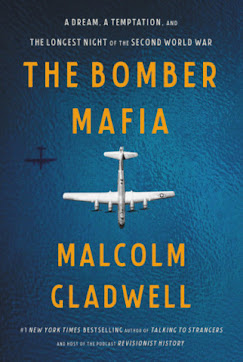
I finished Malcolm Gladwell’s latest book, “The Bomber Mafia”, in less than a day. Then I bought 10 more copies to hand out as Christmas presents.  It’s not a difficult book to read if you’ve spent four decades tied to the United States Air Force (USAF) with many of your formative years spent inside the Strategic Air Command (SAC).  During that time, I had the chance to personally weigh the morality of high-altitude bombing as an offensive first use weapon or better as part of the strategic triad of nuclear deterrence.   Sadly, due to Saddam Hussein’s aggression against Kuwait our country went kicking and screaming into the first Gulf War.  In those early days (circa 1991) we ushered in the first war-time use of the Global Positioning System (GPS) and it’s timing to aide precision bombing (more on timing in a bit).  The mighty B-52 bomber, getting old at the time, still in noble service to our Country now another 30 years later.  In 1991 it became new again with the technology that enabled those new GPS guided munitions.  GPS brought about a Revolution in Military Affairs (RMA) for those who study such things.  The pinnacle of air power envisioned by the Bomber Mafia.

Beyond his great storytelling, if you are a military history buff (no pun intended) you should read other recorded military history--not Gladwell’s.  Gladwell doesn’t write for historians. He writes for a more general audience to learn a few things about the human condition.   The stories Gladwell tells in “The Bomber Mafia” have been told before in much more depth, in numerous books, and in many Hollywood movies.  The simple insight that Gladwell delivers on the human condition is that some military leaders are profoundly moral who strive to reduce the atrocities of war based on their decisions. Other leaders are great tacticians.  These tacticians can execute a plan of action and solve a set of complex military problems through operational art regardless of the technology focused primarily on effect. Finally, Gladwell also tells us, that some military leaders are just plan sadistic. In this manner Gladwell captures the richness of human behavior, our idiosyncrasies, and our strengths and weaknesses.  He doesn’t pass judgment.  He just puts it out there for you to consider the right and wrong of it all.

Anyone in the military should have studied WW II in great depth.    Anyone who considers themselves well-read should also know about the great works of fiction coming out of WW II.   Novels such as Slaughterhouse-Five, by Kurt Vonnegut, and Catch 22 by Joseph Heller to name the best—in my opinion. Some recent histories include stories of courage and the many thousands of personalities of that infamous era.  For instance, the story of Louis Zamperini the Olympic athlete who’s his trials and tribulations with the B-24’s in the Pacific were told by Laura Hillenbrand in “Unbroken”.  WW II will continue to be studied by historians for the length of human existence. In time most will end up being a mere chapter in a high school history book.  That is, unless, great stories and anecdotes told by great authors and storytellers like Gladwell (and Hillenbrand) persist.  

As to the sheer horrors of war, Gladwell does more than just hint about them.  He discusses the development of napalm and it’s effective use against the dense, tinderbox homes in Japan where 100,000 died in a single firebombing raid on Tokyo.   He glosses over the firebombing of Dresden, Germany the topic of Vonnegut’s nightmare, attributing only 25,000 to that conflagration. Although the number who died in Dresden is disputed and arguably higher.  Japan is significant in that Curtis Le May did not stop with the firebombing of Tokyo.  He went on to firebomb as many as 67 additional Japanese cities each with a similar outcome.  Most of the population of each city was decimated.  A fact that gets whisked away in the days after the nuclear missions to Hiroshima and Nagasaki. In firebombing Gladwell tells the story of human babies igniting on the backs of their fleeing mothers as the hellish furnace of the conflagration consumed every life in its path.  In addition to the horrors of firebombing, in the nuclear conflagration the horrors of radiation sickness would soon materialize.  Like Vonnegut, you cannot not read these passages and find any nobility in war.  The book “War is a Force that Gives Us Meaning”, written by Chris Hedges in 2002, is tells us perhaps, why humanity wages wars. Gladwell reminds us why we must continue to find ways to solve our differences peacefully even in the midst of wanting to strike out against those who oppose us, conquer us, or would lead us into tyranny.

To be sure Gladwell makes a few technical errors and errors of historical fact.  But that does not detract from the story of what happened.  This is not a revisionist history of WW II aerial bombing as some of military critics of his work have stated.  These men existed.  These bombing missions happened.  The results are historical fact, Germany was defeated.  Japan surrendered. Those who push revisionist, anything, really don’t understand what history books are trying to deliver to the future.  

Now a little more about the book.  The Bomber Mafia grew up in Maxwell AFB, Alabama, by military aviators believing several things.  First, they believed that air power could help bring wars to a close faster.  The method theorized was the precise aerial bombardment of strategic targets and choke points that could cripple an adversary's ability to wage war.  The doctrine of strategic bombardment to crush those critical nodes of production and transportation is sound provided effect can be delivered precisely.  That doesn’t preclude the use of boots on the ground or naval blockades or the coming requirement to own the high ground in space.  In the 1940’s space was the domain of HG Wells. And as for air power, it was a pipe dream back then.   Second, these air power theorists believed the use of area bombardment was morally obtuse. Decimating a country’s population to include the non-military, the civilians, the elderly as well children is a pretty evil enterprise no matter whose side you are on. As the 3rd Reich hit out at England during the Battle of Britain, many English, of course quickly overcame their squeamishness about bombing populations as they themselves were the target of the German evil.  You can almost hear the English pragmatism in doing unto the Germans which was being done unto them.  This is of course why leadership should always be sane and moral. You can’t let emotionalism govern a country.  

Gladwell is light on air power doctrine as it would take volumes to really dive into it.  Instead, he focused on those two competing methods of aerial bombardment through the eyes of Curtis LeMay and Haywood Hansell.  Where, may I ask, is Giulio Douhet, Billy Mitchell, or the modern-day John Boyd and John Warden?    Hansell was basing aerial bombardment on strategy and morality.  LeMay was getting the job done.  These are not mutually exclusive.  But it’s worth noting that in general, air power is an RMA, it just took 80+ years for air power to hit it’s stride after it’s invention at the start of the century.  Gladwell spends time on the technology of the Norden Bombsight.  A closely guarded secret.  The bombsight was a marvel of technology akin to the first maritime chronometer.  Essentially a highly accurate clock with a telescope.  Daytime was a must.  Straight an level flight at a precise altitude was a must.  Straight into the target was a must.  With all those in order, the bomber would look through the bomb sight and with many adjustments made for every variable Norden could think of, precisely drop the bombs at the right time.  The math worked, with this proper clock, the bomber could time the release of altitude to hit a pickle barrel on the ground.  Reality was something completely different.  In fact, bombers could still not hit the broad side of a barn, or many barns, or the farm or many farms.  For numerous reasons, the bomb sight simply didn't work as promised.  Theory would have to wait.

This is a lesson for the current technology mafia who believes with unwavering optimism that the RMA before us, has to do with software and networks.  That somehow the Internet is an RMA by itself.  The theory behind that RMA started 25 years ago with chorus of networks being the solution with network centric warfare (NCW) being the crowning achievement.  Since that RMA was never achieved it’s now been augmented with the refrain that faster agile software development will deliver the heretofore unachievable.  It’s now referred to as the kill-webs as opposed to NCW but at the end of the day, it’s still not an RMA.  You don’t achieve combat power with a network even with the faster software a network can enable.  There is no warfighting energy contained in a network no matter how many nodes exist.  Further, if you connect everything, apart from being supremely difficult, you introduce an information problem that still, no matter how many temporal increments of Moore’s law we advance through, the information problem will remain intractable or in the parlance of computational complexity, NP-Complete. Wait, Artificial Intelligence.  Wait, quantum computing. Keep waiting, and good luck.  Instead of waiting on magic, what’s fascinating in Gladwell’s pages is the way Curtis LeMay overcame the greatest technology of the day, that wasn’t working, to force a winning outcome.  All the technology in the world (at the time) and the B-29 couldn't overcome the lack of an accurate bombsight.  The bombsight that would enable precision, high altitude bombing, was in reality unobtanium. In essence, a unicorn.  In the presence of the unobtanium, LeMay moved away from precision, high altitude, daytime bombing of strategic choke points and completely changed the tactics.  Instead, he went with low altitude, area bombing, and introduced napalm because he knew that flammable tinderbox houses in densely populated areas of Japan would be the target.

What allowed this change was the flexibility in the operational art of war with LeMay not tied to one doctrine of aerial warfare, but rather a doctrine of solving problems faster than your adversary can react.  Flexibility is the key to Air Power (Douhet). React faster than your adversary (Boyd).  This is the insight that Gladwell is writing about.  Though it may be hard for the average reader to ferret out without deeper history.  There is more here, but I've written enough.  Read the book.  It's less than 200 pages.   I’m going to start with 5-Stars because I love this book.  I’m going to deduct 1-Star for several technical errors and 1-Star for missing the attribution of other great air power theorists.  I’m going to add back 1-Star for the part of history often glossed over, specifically, that LeMay bombed 67 Japanese cities in total.  Capitulation without the atomic bomb was at hand.   The argument for use of the atomic bomb was that boots-on-the-ground would be necessary for the win but cost an ungodly number of American lives in the assault.  It's not at all clear that would have had to happen. Air power might have succeeded without the nuclear boost…at this point we will never know. 4-Stars for Gladwell’s jaunt into air power for those who believe in a strong Air Force and air power theory. 

Sunday, December 12, 2021

Shooting Craps with the Cosmos


When you think of classic science fiction you always start with HG Wells.  And then you can say Isaac Asimov,  or Arthur C. Clarke.  But you can’t go too much further without saying Ringworld.  You may not say Larry Niven directly--although you should---but you can’t, not, include the title Ringworld in the same breath when mentioning the greats.  When you pull science fiction apart, there is the improbable and the probable.  HG Well was always inside the probable.  Isaac Asimov and Arthur C. Clarke, to some extent, try to be.   Larry Niven is so far outside the probable, as to be light years into the future and somewhat beyond that… Not only is a Ringworld itself so improbable, most of the concepts contained within Niven’s novel are also improbable and to be entirely accurate, physically impossible.  Even his notion of probably, the math he tries to imbue, not just the science, is wrong.  Let’s just completely forget about  physics, let’s forget science, let's forget math…and go for it. It is fiction after all… 

Thus Ringworld, and who wouldn’t want to live there, can’t be real.     A mere factional wedge (or belt)  of a Dyson sphere inside the Goldilocks zone circumscribed around its central star. Perfect is all it’s design detail.  Safe from anything that might threaten it.  Engineered to hold not the people of an overpopulated planet, but perhaps a universe full of people, millions of worlds.   From the tiny thread that holds the sun shades in orbit above the ring surface to the speeds necessary for the travelers in the story to get to Ringworld, Niven is completely wrong.   All of it.  To wit, Larry Niven pushes back against his critics and says to them with his own axioms, when Arthur C. Clarke tells us, “Any sufficiently advanced technology is indistinguishable from magic”, Larry Niven says, bite me, rather more correctly, “Any sufficiently advanced magic is indistinguishable from technology."  Niven breaks the paradigm and as the greatest novelist of all has told us, just for the fleeting instance we stretch our arms out further, and beat back against the current of the genre, Ringwold is magic.  Magic that is brought alive through Niven’s narrative. It is pure science fiction.  No wonder it won awards.  No wonder it still inspires me today.  No reason, necessarily, to read further into Niven series…and I never have.  What must follow in his series (pure speculation) can only be at best an improbable defense for the impossible or at worse an apologetic

Yet here we are with such a fantastic story, without much of the defining detail as to how? To me, to provide that defining detail would be crushing. It would  lose it’s fantastic nature.  Even millions of years into the future.  There is no physics that could possibly support any of it. So don’t try.  This scale rivals the scale of human comprehension.  It is massive and beyond understanding. And the result is breathtaking.   Three  million times the surface of the earth--with walls around the edges stretching 1000 miles high. A lifetime just to walk across it’s 100,000 mile width laterally, let alone head out toward the base of the arch…an the mirage of the ring, disappearing behind the horizon and reappearing as the ring itself.  I don’t know what Niven was thinking…but we are so much richer for him having created it.  A book shelf needs bookends…Ring World is my book end for science fiction. 

When I read Ringworld in my teens it was real.  Not the reason I became an engineer…but certainly an  influencer.  Reading it again in my 50’s it’s so physically wrong as to be laughable but so fantastically right with regard to what science fiction ought to be.  Too many writers are trying to stay within the realm of physics as they know it…not courageous enough to take their potential detractors head on.  Again, bite me, it’s fiction.  It’s a magnificent flight of fancy.  If you want exactly the engineering required and accept no possibility of magic go read Weir, only The Martian, however. Artemus sucks, although, admittingly technologically accurate.    Despite the many criticisms, Niven’s awards are absolutely  justified and the book itself will always stand the test of time.  It will always be millions of years in the future…at the time when spooky magic at a distance is understood and magic becomes ubiquitous.  But there is so much more beyond technology inside it's cover.

Niven also dealt with several sticky social aspects of multiple alien species living together, super advanced life forms (Nessus the puppeteer), a warlike species that look like giant cats (Speaker to Animals a Kzin, and of course the humans (Wu and Teela -- who are on a life extension program).  Niven has been criticized, probably by the woke generation, for being somewhat bleak in his portrayal of women.  Given that he wrote this in the 60’s can’t we give that a pass?  His characters are all somewhat of a stereotype.  Turns out stereotypes exist for a reason.  Wake-up woke people and chill the hell out. Yes cats eat meat.  Carnivores eat meat. Get over it.

Yet despite his somewhat old fashioned view of women and despite the  colossal  story and engineering behind the existence of the Ringworld itself,  the actual story being told, and the hero of the story is the female human, Teela Brown.  The story actually isn’t about technology, Niven just needed a backdrop for what he calls the luck of Teela Brown. The real story is about what Einstein calls, shooting craps with the cosmos.  Does God roll the dice?  Can it happen? Does it happen? What happens when it happens?   Beyond the gift of Ringworld, Niven has given us the gift of Teela Brown.  Whereas Teela never became the messiah, it’s not too far of a stretch to understand that’s where Niven might have headed had he not gotten caught up in the debate over the technology.  Particularly if the Teela Brown character would have been slightly more appealing.  Had he written her character today, and dressed her in prose to resemble a smarter character, a Lizbeth Salander for example, he might have given us a Christ like figure. What we do have instead is from the Marvel series is the Domino super hero.  Cute…and powerful…but not the messiah.  Marvel gave us Domino in 1991.  Twenty years after Niven gave us Teela Brown as the savior of Ringworld. Niven’s aspirations for her must have been incredible.  And certainly the math he chooses to use/or ignore, is just as fantastic.  He does state early on that random flips of a coin have no memory. He must have hated that…or couldn’t understand it.  To review basic probability,  one flip of a coin is 50/50 heads or tails.  Another flip is 50/50 just the same.  Just because the more recent flip was 50/50 there is no bearing on the subsequent one. The next flip is again, 50/50.  And so it goes, as Kurt Vonagut might say.   If you are looking for a heads-up coin flip  every time, Teela Brown is that coin flip.   The problem here is that Niven, while examining the material, never quite understood what was going on…and couldn’t explain it sufficiently.  Had he argued the math, only slightly better, he might have been considered a theoretical genius in the area of statistics.  He might have handed the  mathematicians of the world a conjecture with consideration.

So here’s exactly what’s happening with Teela Brown…that Nevin couldn't prove, but surely wanted to prove.  I’ll call it the Niven conjecture.  He might not have understood what he was saying either.  Teela Brown is not  flipping the coin repeatedly and landing on heads.  She’s switching her choice back and forth as the coin is being flipped, seemingly without memory, and choosing heads or tails each time.  But in her case, she’s always right. She always makes the right choice.   The first time you flip, it’s heads or tails. Then you flip it again and you have heads, or tails, but also the branch of what might have been.  Then you flip it again, and you have heads or tails and what might have been and what might have also been.  Then you flip it again and have heads or tails and what might have been and what might have been and what also might have been.  This goes on forever.  Everybody’s life plays out according to one of those paths. Teela’s life plays out precisely because she is always on the path that is correct as to the flip of the coin. The longer the flips go on…the longer the sequence.  Those with an infinite mindset know that there are an infinite number of paths and thus if an infinite number of monkeys were seated at a typewriter and were allowed to hit the keys continuously, one of those monkeys would type out the novel “War and Peace”.  Well I can’t find the number of letters in that novel by Tolstoy but he put 587, 287 words into “War and Peace”…so loosely multiple the number of words by  five to account for spaces and punctuation so maybe three million individual characters.  This is the number of unique characters a monkey would have to tap out all in exactly the right sequence all in order to create the book.  So if that were the case it would not take an infinite number of monkeys…that number also is finite and knowable…it’s just very big.  It would take 3 million factorial x 26 plus a few special characters.  (3,000,000! X ~26)  That’s 3,000,000 x 2,999,999 x 2,999,998 x 2,999,997… all the way to 1.  It’s a big big  number, a really really big number…but it’s not infinite.  

But that’s also not what’s happening with Teela Brown either.  Day to day, minute to minute, we don’t have to make a life and death decision.  Evolution has seen most of already through over the past six billion years. We already have much of the luck of Teela Brown behind us.   Thus the remainder of our life isn’t random monkeys typing “War and Peace”.   We live perhaps for 35,000 days.  We don’t even make a life or death decision every day…if we would do that, a lot more of us would be dead.  The question correctly posed, is how many near death experiences befall us throughout  our lifetime.  That is for sure, a much smaller set.  Thus, the number of monkeys required to sit at the keyboard and type our life is a lot closer to the book “Goodnight Moon”.  There are 131 words in Goodnight Moon.  So let’s go with 131 characters that a smaller set of random monkeys would have to strike the keys on a typewriter to randomly write the story of Teela Brown's life so 131! X 26 or 2.2 x 10 raised to the 223rd power.  The question is can you find such a person living…and if they found that person in Teela Brown?    To be sure the number would need to be much smaller…the number would need to be on the order of no more than 15 life or death decisions…and you actually could find such a person…given that about a trillion people were your sample size.  1 x 10 raised to the 12th power. 

Anyway, that’s not the conjecture.  The Niven conjecture isn’t about doing the actual math.  Because as we’ve learned, math from statistics will not work here.  It’s wrong. Statistically Teela Brown will not win. She will lose, and lose quickly.  As she begins flipping the coin will lose, if not at 15 flips, shortly thereafter.   Beyond that the numbers move toward infinity, or as close to infinite as the human mind can comprehend.  That must not be what’s happening statistically.  If we are to believe there is math behind it, something else must be going on.  I can’t figure it out.  But someone, somewhere might.   The conjecture therefore  is more about whether or not  something mathematically magical is happening on the way to this  infinity.  And the answer is, yes.  It must.  Why? Because we are all here to observe the outcome of this math.  Every single life form on planet earth, animal, insect, plant, has survived though time to be living and breathing the atmosphere of our Earth.  Everything, to exist today, has been done with the Luck of Teela Brown. Is this magic?  Is this deterministic?  Is this proof of God?  That’s what Niven was really talking about when he wrote Ringwold.  And beyond the technology we have the math behind his magical thinking.  I like that Niven is a magical thinker.

I give Niven 5 full stars for Ring World.  It’s just what science fiction should be…extra-ordinary science (and probability) wrapped up in brazen, unapologetic  fiction!


Friday, November 26, 2021

Crime, Seth Rogen Tweets, & What Would Jesus Do?

On the surface, one might consider the latest out of Hollywood tweet by the comical Seth Rogen, to be at the pinnacle of woke liberal progressive tripe and a danger to the country.  “Get used to it”.  We can dismiss petty crime.  You can read about his tweets here.  

https://www.mediaite.com/news/seth-rogen-defends-car-break-ins-in-los-angeles-i-dont-personally-view-my-car-as-an-extension-of-myself/

Essentially he is saying stuff like, if you live in the "big-city" you can expect to have your car broken into, get over it, seemingly giving crime a pass.  This should, on the surface, rub every law abiding citizen wrong.  It should also make Republican’s go ape shit. I think we are seeing that ape shit response.  Even from a few moderate democrats.

The complete thoughts here are far deeper and more nuanced for a tweet.  The thoughts here go  so far beyond the pages of People Magazine or the  latest  Woke experience from the progression wingnuts on the left who strive to make the criminals the victims.  Let’s dig deeper.

Let’s start with remembering that very first crime you’ve experienced that was committed against yourself and I’m talking about a relatively petty crime.  A misdemeanor, a theft.  Not a felony, not a violent act. Let's not confuse the two.    Regardless of the petty nature of the crime, who  didn’t feel violated?  It’s still shocking. It’s emotional.  It’s ethereal.  And yes, being violated is a valid expression.   Those who have numerous petty crimes committed against them, without serious mental preparation,  stoic meditation perhaps, rarely can reduce the pangs of violation--even if minuscule by comparison to physical assault or armed robbery, for instance. 

Rogen claims his car has been broken into 15 times.  I hope that’s an exaggeration, but nevertheless, repeated exposure to that same stress, no doubt, will make your mental reaction somewhat less fraught with anxiety.  Certainly, that first night of sleeplessness after experiencing a crime, will abate, if a car break-in has been something you’ve decidedly decided to live with. Doubtful Rogen would feel the same way if his house was broken into, perhaps while resting peacefully inside.  There are other petty crimes.  Having your wallet or purse stolen at the airport.  Having your bike stolen.  Tires slashed.  Hotel room burglarized. Even a home break in, preferably while you were on vacation.  For the record it’s  not petty at all if you are home.  Rogen also claims he's unaffected, because he doesn’t view a car, and the material value of things in the car, as an extension of himself.

To some extent, all of these crimes have befallen me, or someone I know.  They all suck.  Yet here we are, giving crime a pass.  What would Jesus do?  If you steal a loaf of bread to feed your hungry child, should you have your hand chopped off?  These are ethical and moral scenarios that have been explored greatly throughout the literature.  Even better, if you have an expensive car, park it in a sketchy place, leave your wallet on the dashboard, and leave the doors unlocked, haven’t you just explicitly invited the crime?  This would be akin to saying a woman invites an assault by wearing skimpy clothes.  Let’s stop that line of bullshit right there.  No one invites crime against themselves.  Period.  For whatever reason, you parked the car, felt it was safe to run into the 7-Eleven, and did so.  Only to get trapped momentarily in the back of the store and delayed by some high school kid  trying to make a mature selection on which IPA they should try to buy with their phony ID.  It happens.  Next thing you know,  your cell phone has walked out of the parking lot...hopefully after it locked itself. The cell phone can be replaced easily...if it’s an Android.  You’re fucked if you iPhone was stolen and you don’t know your Apple ID or password.  But I digress...

Now another crime story, from the early 1990’s.   My aunt and uncle visited me in Texas.  They were accompanied by their three young daughters.  This story is a bit poignant as my uncle just passed from cancer a few weeks ago and I attended his memorial in Florida.  I actually recounted this tale when I spoke at his celebration.  They traveled in a van, the five of them, around the country having returned to the states for a year furlough, after doing five years of missionary work in a foreign land.  In every sense of the word, these five disciples of Jesus, spinning around the country in a van, doing, living, and breathing God’s word are a living manifestation of His Gospel. Unfortunately their van was broken into in San Antonio.  I don’t remember everything that was stolen.  But I do remember it included personal artifacts, such as pictures from their mission, over the last five years.  Principally the evidence of their mission and the reason for their travels.  Missionaries need sponsors.  Without support they cannot be on the front lines, in far off places, preaching the salvation of the Lord. Missionary work is not a thing without support.  My aunt and uncle were un-phased by the crime. Living true to their beliefs, it was to them, in fact, “God’s will”.  These two beautiful humans are not hypocrites.  In 50 years I have not seen them waiver in their belief in this regard.  Perhaps, given the expression on one of my cousin’s faces at the memorial, when I recounted the tale, the crime was still raw.  I heard her mutter the words, “Ugh, San Antonio”.

Would they excuse the crime, certainly not. Are they bothered by a crime that was most certainly God's will?  Also, certainly not.  The criminal, should he have been encountered, would most certainly have been forgiven by my aunt and uncle .  So has the cancer that ravaged my uncle’s body, so recently rendering him to the Lord,  been forgiven by his wife, now widowed aunt. My uncle, some of his last words, when asked how he was doing? Could only respond, “Better than I deserve”.  Should any of us believe, what befalls us is somehow not  better than we deserve, we have not paid attention to life in general.  Those are strong words and I use them only to set context for this post. Individually, today perhaps, many of you have mighty struggles.  I am not insensitive to that pain and real suffering. Yet we can, in fact, understand and perhaps give it less power over us, as Saint Seth  has perhaps told us in his tweet.

Here’s another crime story.  One that plagued me a few years ago. Forget living in the big city, and locking your car doors.  I fled the city and lived not only in the suburbs, but in a gated community, on a barrier island in Florida. This is the pinnacle of escapism.  I’m embarrassed to say that.  I’m also embarrassed to say our gated community was not free from crime.  Lock your cars the neighborhood youth seemingly checked for locked doors routinely.  This was an insider threat.  What was worse for me, however, was not losing my radar detector, pinched from the glove box one evening, it was losing my bikes directly out of my garage.  This happened twice.  Shame on me for leaving the garage door open, I guess.   Cue my first several encounters with Florida law enforcement.  Turns out, if you want to check to see if your bicycle has been reported, or recovered to law enforcement,  you have to contact all municipalities.  There are at least five  separate municipalities on that barrier island, all within easy bike riding distance.  You can’t just call your local one...chances are the bike left your municipality about 6 minutes after the thief started pedaling. Do the cops in Florida care about bicycles?  No.  This isn’t even a crime in Florida.  Even if they took the bike from your garage. As it turns out, the hoodlum wasn’t actually stealing my bike, they just needed it to travel someplace.  Grabbing the nearest, unlocked, set of wheels, is a mode of transportation.  Florida’s finest advised me to drive up and down the beach-front and look for a place where someone might have needed the ride, and dropped the bike.  I did this.  My bikes never turned up. I started to check to see that my garage door was closed every night.  I never grew insensitive to this particular petty crime.  But perhaps, I didn’t live in Florida long enough.

What am I saying here?  I’d love for someone to put words in my mouth because this isn’t easy.  Don’t condemn Seth Rogen for his liberal views with regard to crime, petty crime.  They might not just be liberal.  He is not the left-wing boogieman you may think he might be.  I’ve just provided two ultra-conservative accounts of the dismissal of petty crime as a part of life, and not just in the big city, code word, urban-environment..  Don’t be a hypocrite.  Live your life, if not in accordance with His Word, in accordance with Seth’s word.  Get used to it.  But you should also lock your doors...


Saturday, June 12, 2021

WHEN Not to Just Do It...

As birds go, I’m a morning lark as opposed to my daughter, who is a night owl.  I rise at 5 am every morning and try my best to stay awake after 9 pm so my wife doesn’t take my drowsiness personally.  She is also a night owl.  There are reasons for this type of behavior.  Daniel Pink has written an accessible--pop science--account of why there are night owls and morning larks and thus why we should pay more attention to the “WHEN” of when we do things.  As the other Byrd’s have told us, “To everything there is a season and a time to every purpose, under Heaven…”.  But really that wasn’t the Byrd’s since they clipped the phrase from Ecclesiastes 3. And Daniel Pink clipped the concept from the Bible to give us his NYT’s best seller, “WHEN”, his fourth book.  This is an enjoyable romp through what we have always suspected about the value of time...and why we shouldn’t force our night owls to wake up and get their day started.  Society in general is not actually made up of night owls or the morning larks.  As a species we are more like daytime chickens. Evolutionarily speaking, we’ve only had  a few thousand years to evolve into a world of artificial light.  Like chickens, we can only see in the daylight, so what’s up with early mornings and late nights?  For hundreds of thousands of years homosapiens have risen with the sun in the east and gone to bed when it disappears in the west...just like chickens. Thus we could all learn a lot from a chicken's schedule by mimicking their behavior and time patterns. They stay safe from predators and work hard. They even adjust for daylight savings time.  But that’s a different story.

In his book, Pink has aptly captured the science surrounding when our human bodies perform the best given what we’ve known for years to be the rhythm of our physiology. Typically we choose to ignore these cycles by forcing ourselves to do things that make us wake up on the wrong side of the bed...like setting an alarm clock. Only night owl’s need alarm clocks--like my daughter which they mostly ignore when it goes off. Morning larks wake up au naturel (don’t worry I’m talking about time, not attire). That’s me saying that, not Pink.  Pink is searching for a formula to better “hack” your own body into optimal performance by staying attune to your highs and lows of energy and mental acuity during the course of the day.  For instance, if you force high school students into class early, when their brains are not awake, they will underperform.  Also, if you force these same kids to do analytic work during their off peak hours, say math in the afternoon, they will underperform.  He’s talking about our kids, for the most part, but everybody does better if they are attuned to this cycle of optimal performance.  Between chapters  he presents his formula for how to hack your own body  to sync up with it’s internal performance clock. This is a useful self-help tool if you haven’t already discovered how to do it through self observation.

Not only should you do this yourself, you should help your kids through the selection of optimal “WHEN”.  Also, we should be aware of the people around us and when they are at their optimum performance if we need them for something. For instance, the right time for elective brain surgery is not during the late afternoon.  If you are going to select for that type of procedure pick a surgical lark and go in the morning.  Pink uses the example of colonoscopy and how mistakes are made during the procedure when it is performed later in the day. Typically, that exploration is done in the numerous colonoscopy sweatshops that freckle our country.  If you’ve ever been to one of these medical locations it looks and feels like an assembly line...customer after customer.  As it turns out, and this is not contained in Pink’s research, there are not enough doctors performing colonoscopies in this country to accommodate the American Medical Association’s advice for everyone over the age of 50 to have an annual colonoscopy.  Further, if everyone chose to have their procedure done in the morning, where the doctor was at his best, the number of available colonoscopy lifeboats would be reduced by half, or the same ratio of lifeboats available on the Titanic.  So schedule your colonoscopy early in the day  so you don’t have to take that afternoon lifeboat. As an aside, here's a helpful tip for those in need of a colonoscopy.  It turns out some doctors prescribe drinking a gallon of water with a full bottle of Miralax in preparation for your procedure.  If your doctor prescribes the standard gag inducing cocktail of magnesium citrate and water tell them to bugger-off and go find a doctor who will prescribe the Miralax solution.  You will be much happier.

As a self help book “WHEN” is a must read...at least the first four chapters.  He establishes his case for the rhythm and performance of our bodies which is pretty much an open and shut case.  It’s undeniable and you should adjust your schedule to do important things, like making critical decisions, at the right time for you.  It’s easy, once you identify your peaks and lows.  Then he walks through how to complete a project, any project, that has a natural ebb and flow starting with the natural excitement at the beginning, moving through the waning of interest and the slog of slow motion in the middle, and finishing at the end of the activity with a flourish.  All of this makes perfect sense and is as practical as any management/self-help book I have found.  Mapping your highs and lows into this type of schedule really works.   I’ve already adopted some of his techniques for getting through the slog of the middle zone.  So many things go unfinished when we encounter the mountain before us as we climb through this ugly place. Thomas Edison said, “Genius is 1% inspiration and 99% perspiration” meaning it takes a lot of work to get through this middle zone.  Thus in my mind, most of us might actually be geniuses if we could get the 99% of the activity completed.   Edison was a night owl, by the way.  Pink tells us that...it’s odd that he left out Edison’s most famous quote since it fits perfectly.

In the final section of the book, Pink takes a hard left turn and drives into a story about the delivery of Dabbawala lunches in Mumbai, India. As most of his stories go, he spins a good yarn and tells these anecdotes with very accessible prose.  However he’s no Gladwell when it comes to defining the “So What?” of his story. Gladwell is the master of answering that question.  Alas, “WHEN” will not, and cannot, become a household word as a result.  Also, try doing a Google search on the word, “when”.  It’s a bad choice...but perhaps that’s his editor's fault.  I digress.  The story of the Dabbawalas has absolutely nothing to do with the subject of the book.  Totally weird.  In  this chapter he calls “Syncing Fast and Slow” perhaps he is attempting to call out to the guardian angels of Daniel Kahneman?  Pink is clearly an acolyte of the Nobel Laureate, having mentioned Kahneman several times.  But in the end, the chapter heading and the story of the Dabbawalas just doesn’t sync (no pun intended) with the topic of “WHEN” to do something important..  

I can just imagine the writing slump Pink was going through during and decided to use his new found tools to move through this depression.  Then he finished with a flourish as he had the excitement to write the story of the Dabbawalas--which he used to add meaning to his story.  He even included pictures...which was weird. Well look, it’s a good self-help book on time management and motivation.  It doesn’t have to have eternal meaning.  It’s interesting that Pink claims he has adopted some of his new found perspectives having researched this book and put those insights to use.  He came to believe he had been doing things wrong most of his life...which is a bit confusing as he has been a productive and prolific writer this being his fourth book. He already had skills that worked and many of the reviews I have read claim some of his earlier work is superior.  I’ll have to give another one of his titles a go just to see for myself.

This is a solid book, certainly the first four chapters. His writing style is conversational which makes it easy to read.  His wife, apparently from his acknowledgement, read the book aloud cover to cover...which has always been the best way to write something and make it easy to read.  Four stars for a solid book.  I have to subtract one star for a finish that I simply didn’t understand. I thought I was reading a different book.  But when it comes to the bulk of the material on “WHEN” to do, or not to do, something...don’t just do it.  For the important stuff, pay attention to the time of day when you are at your optimum and save other times to slog through the mountain in the middle of life.